Hiring an AI development company is no longer about finding a team that can build a demo. Most organisations already know AI matters. The sharper question is whether a vendor can ship something reliable, safe, and useful inside a real business process - and keep it running after launch.
If you are also deciding whether machine learning belongs in a product workflow first, start with how machine learning powers better product decisions.
What proof to ask for before you shortlist
Start with delivery proof, not promises: case studies, working product examples, architecture summaries, or named testimonials. If NDAs block client names, ask for redacted artefacts - problem statement, approach, stack, deployment context, and the KPI used to judge success.
Look for evidence that the company understands the difference between an AI feature and a business outcome. A strong partner can explain whether they built predictive analytics, NLP, computer vision, or a generative workflow - and why that method fit the job. A team that shipped an internal chatbot is not automatically ready for a regulated decision-support system.
Ask one direct question: what changed for the client after launch? If the answer stays vague, the work probably stayed at prototype level.
Pilot versus production
Production readiness is the dividing line. Many organisations use AI somewhere; far fewer have scaled it. You want one scaling story more than five pilot stories - deployment, monitoring, security, adoption, and iteration after the first release.
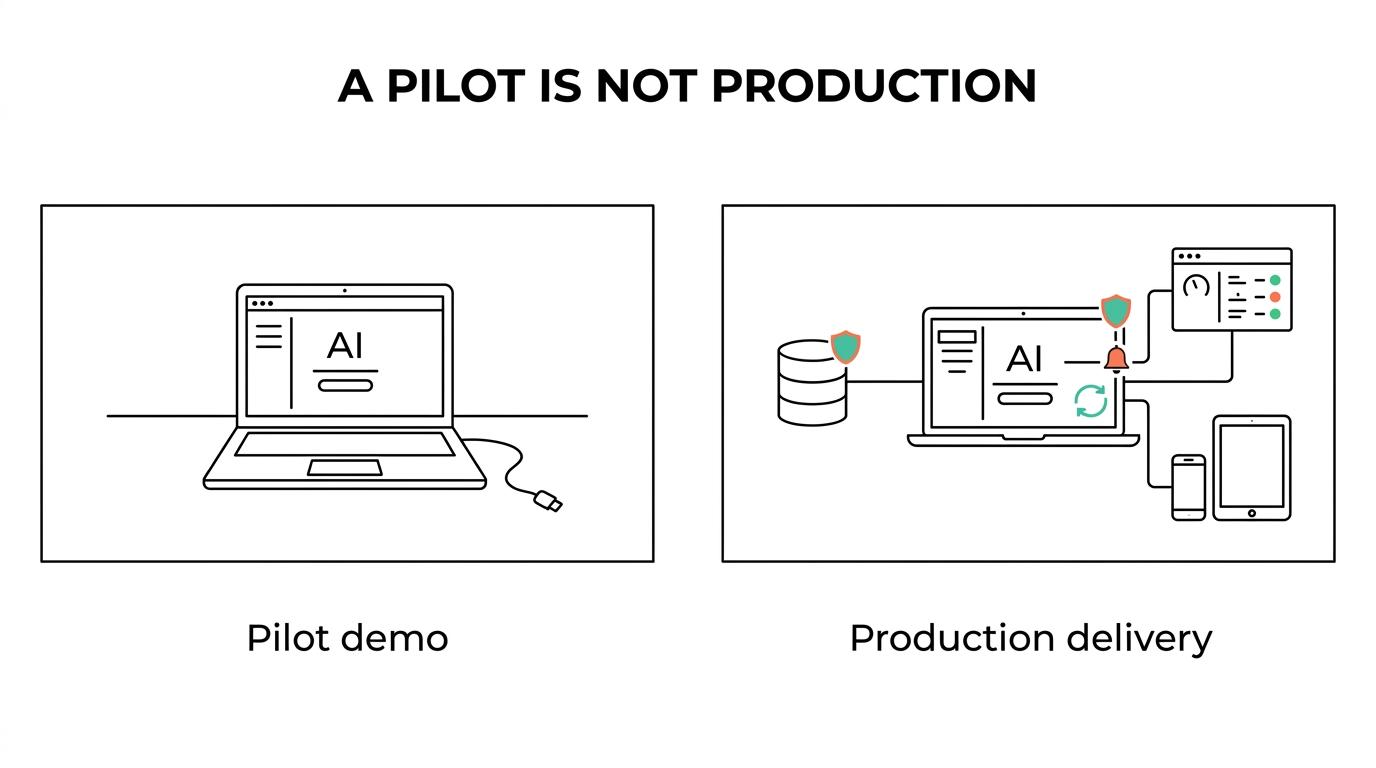
Inspect the operating model. Ask how they manage evaluation baselines, prompt or model changes, drift, fallback behaviour, and human review. If generative AI is involved, ask how they test hallucination risk and how often evaluation sets are refreshed. If agents are on the table, ask what guardrails limit autonomous actions and when control returns to a person.
Then test the handover. Who owns alerts, retraining, cloud costs, model updates, and incident response? A good prototype is not a small production system. It is a different stage of work with different controls.
Criteria that actually compare vendors
Compare on operations, not cosmetics. Put every shortlisted firm through the same written questions and score them against the same standard:
- Delivery proof: shipped systems, named references, or redacted case evidence
- Method fit: predictive, NLP, vision, retrieval, or agents matched to the use case
- Governance: documentation, testing, human oversight, risk tracking
- Workflow redesign: changing real processes, not only adding a model
- Integration depth: APIs, data pipelines, security, product engineering
- Ownership terms: code access, documentation, maintainability, post-launch support
- KPIs: measures tied to cost, speed, quality, revenue, or risk
- Adoption: user enablement and internal capability building
If two firms look similar on paper, clearer written assumptions usually beat presentation polish.
Specialist or full product partner?
Choose a specialist when the problem is narrow and you already have strong product, design, DevOps, and application teams. You may only need help with model selection, fine-tuning, or evaluation.
Choose a full product engineering partner when the work also touches data pipelines, applications, workflow redesign, launch, and long-term ownership. Many projects fail because the model gets attention while authentication, permissions, observability, APIs, fallbacks, and user experience do not. If the use case affects customer-facing software or operations across departments, breadth is often the safer call - especially when the surrounding platform needs custom software development as well as models.
Governance before you sign
Assess risk management before procurement, not after launch. Frameworks such as NIST’s AI Risk Management Framework and ISO/IEC 42001 point buyers toward documented controls, defined responsibilities, and repeatable risk treatment. Your supplier does not need a specific certificate to be credible, but they should explain how they identify risks, assign owners, document controls, and review outcomes.
Weak governance does not speed delivery. It blocks scaling, because every new use case becomes a fresh risk debate.
Useful buying signals:
- Documentation: model assumptions, data lineage, prompt versions, test results
- Risk controls: bias checks, security review, fallback rules, human escalation
- Roles: who approves releases, handles incidents, and signs off on data use
- Evaluation: offline tests, live KPIs, and thresholds for rollback or retraining
If a vendor cannot show a sample risk register or evaluation template, ask why.
Data readiness and workflow design
Weak data readiness shows up when you ask process questions. Move quickly from “what model?” to “what decision, what data, and what behaviour changes after deployment?”
Define the action the output is meant to trigger. If nobody can name it, you do not have a product requirement yet. Then ask about the data path: source systems, cleanliness, freshness, gaps, and who labels data if labels are needed. “We’ll sort that later” usually means budget and timeline risk.
AI rarely creates value in isolation. If predictions arrive too late, staff do not trust them, or approvals still sit in an inbox, gains vanish. If the vendor can describe the before-and-after workflow on one page, the project is probably ready to scope.
If core systems are already fragile, read 6 signs you need enterprise software development soon before you layer AI on top.
Pricing and ownership
The cheapest proposal often becomes the most expensive. Real cost depends on scope control, cloud usage, support, and who owns code, pipelines, prompts, and deployment assets.
Fixed-scope pricing works for narrow problems with stable requirements. It can also hide risk when data quality or evaluation results force change. Time-and-materials or sprint pricing handles uncertainty better only if milestones, reporting, and acceptance criteria are visible.
Check these terms line by line:
- IP ownership: source code, prompt libraries, evaluation datasets, deployment scripts
- Third-party costs: model APIs, hosting, vector stores, observability
- Support: bug fixing, retraining decisions, SLAs, and exit handover
Maintainability should rank alongside price. A low quote with opaque code or a closed handover is rarely a bargain.
First 30 days after you hire
The first month should produce clarity, not theatre. By day 30 you should have a defined use case, baseline KPIs, agreed risks, a technical architecture, and a delivery plan with named owners.
- Week 1: lock the problem statement, success criteria, user groups, constraints, and decision flow. If there is no primary KPI, pause and tighten the brief.
- Weeks 2-3: inspect source systems, integration points, test sets, and what “good enough” means before anything goes live. Review security, privacy, and access controls.
- Week 4: a written roadmap covering build phases, release gates, governance checkpoints, fallback plans, and who owns iteration after launch.
If the vendor spends 30 days producing only high-level slides, you have learned something useful early.
A strong first month turns AI from a promising idea into a governed product decision. If you are shortlisting partners for production AI work, book an assessment to talk through use cases, proof points, and a delivery path you can own.